Guide, 12 min
Titanium, stainless or non-stick: what actually happens in the pan
What each surface does to heat, to fat and to your food, and which of the three is wrong for the way you cook.
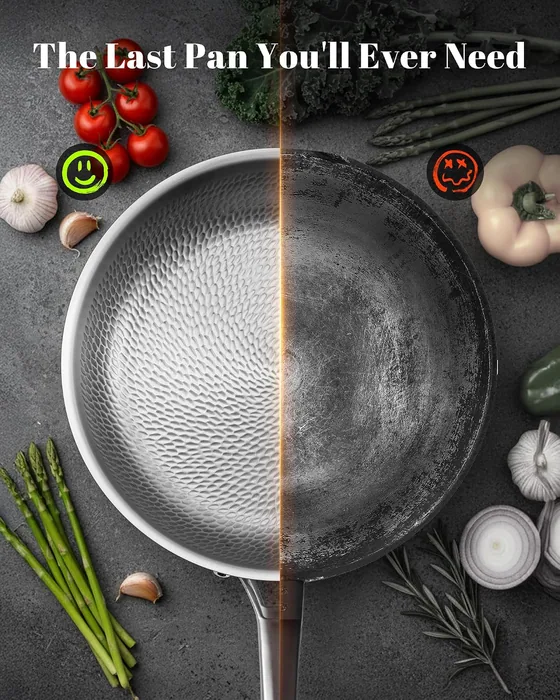
A pan is a heat translator. It takes the fire under it and turns it into a
browned crust, a set egg, a reduced sauce. The surface between the heat and the
food decides how that translation goes. Not whether it works at all, most pans
will cook something. But whether the food releases cleanly, whether the heat
arrives evenly, whether the pan itself stays out of the meal.
Three materials dominate cookware today: titanium, stainless steel, and
chemical non-stick coatings. Each one handles the two fundamental jobs of a
cooking surface differently. Those jobs are managing heat and managing fat. Get
the match wrong and you fight your pan every morning. Get it right and the pan
does most of the work.
This guide walks through what each surface actually does, not what the box says
it does. We look at how they conduct heat, how they age, what makes them fail,
and which one belongs in your hand for which task.
What a cooking surface has to do
A pan surface does two things. It moves heat from the burner into the food. And
it keeps the food from bonding to the metal while that heat does its job. Every
material in a kitchen solves these two problems differently, and the difference
shows in the food.
Heat movement matters more than most people think. A material that conducts
poorly creates hot spots. The center of the pan scorches while the edges stay
cool. You get a burnt middle and raw edges on a pancake. A material that
conducts well spreads the heat across the whole surface. The pan becomes a
single cooking zone instead of three different ones.
The anti-stick side is trickier. There are two ways to keep food from bonding
to hot metal. One is a chemical barrier, a coating between the metal and the
food. The other is technique with heat and fat. Most home cooks prefer the
barrier. It is easier. But the barrier has a lifespan, and when it ends the pan
goes with it.
A surface also needs to stay out of the food. This sounds obvious, but not
every pan material manages it. Some coatings shed particles as they age. Some
metals react with acidic ingredients. A surface that does its job well is one
you never taste.
Titanium: the metal and the myth
Titanium cookware carries a reputation for being the healthy choice. The
the VEDNHOL kitchen store banner says it directly: "Health Is The Most Valuable Thing We
Have. Titanium Kitchenware Protect It." The appeal is real. Titanium is
biocompatible. It goes into surgical implants and dental posts. The body does
not reject it. That makes it a compelling material for something you cook with.
But pure titanium has a problem in the kitchen. It is a terrible heat
conductor. On its own, titanium moves heat about as well as a ceramic floor
tile. Put a pure titanium pan on a burner and the flame sits under one spot
while the rest of the pan stays cold. You cannot cook an omelette on that.
The VEDNHOL Titanium Hammered Pro line solves this with a composite base. Under
the titanium cooking surface sits a multi-layer construction that does the heat
work. An aluminum core spreads the heat across the pan bottom. A magnetic steel
layer makes it work on induction. The titanium stays where it belongs, on the
surface touching the food, while the layers underneath handle the physics.
This matters for more than even cooking. A pan that heats evenly needs less fat
because there are no cold spots where food sticks. It responds faster when you
adjust the flame. It does not warp because the layers brace each other. The
titanium gives you the non-reactive, biocompatible surface. The base gives you
a pan that actually cooks.
What a layered base changes
A pan with a single metal layer behaves like that metal. Aluminum heats fast
and evenly but scratches and reacts with acid. Steel holds heat well but
conducts poorly. Titanium conducts poorly and does not react with anything. A
single-layer pan is always a compromise.
A multi-layer base breaks the compromise. It puts the right material in the
right place. The cooking surface can be something safe and non-reactive. The
heat-spreading layer can be something conductive. The bottom layer can be
something induction-compatible. You get the benefits of each without the
weaknesses of any.
The Hammered Pro construction in VEDNHOL titanium range works this way. The
titanium cooking surface is PFAS, PFOA and PTFE free. There is no chemical
coating to wear off. Under it, the composite base handles heat distribution.
The solid titanium handle stays cool on the stovetop. The whole pan goes from
burner to oven without complaint.
PFAS are widely used, long lasting chemicals, components of which break down very slowly over time.
Explained
This layered approach also affects durability. A chemical non-stick pan fails
when the coating scratches or peels. A titanium pan with a composite base has
no coating to fail. The surface is the pan itself. It will outlast any coated
pan by years, and the heat performance stays consistent because the layers are
bonded, not applied.
Stainless steel: the workhorse surface
Stainless steel is the default serious pan material for a reason. It is nearly
indestructible. It does not react with tomatoes or wine or vinegar. It takes
high heat without complaint. It goes under the broiler and into the dishwasher.
A stainless pan bought today will still cook dinner in thirty years.
The trade-off is that stainless sticks. It has no chemical barrier and no
natural non-stick property. Food bonds to hot stainless if you do not manage
the heat and the fat correctly. A dry stainless pan on high heat will glue an
egg to itself in seconds. The same pan with the right preheat and a thin layer
of oil will release that egg cleanly.
The VEDNHOL Tri-Ply Stainless line uses a three-layer construction. An aluminum
core runs through the entire pan, not just the base. The steel on the outside
protects the aluminum and makes the pan induction-ready. The steel on the
inside gives you the cooking surface. This full-body layering means the sides
heat almost as well as the bottom, which matters for sautéing and reducing
sauces.
Stainless teaches you to cook. A non-stick pan hides temperature mistakes. Food
releases whether the heat is right or not, until the coating wears out.
Stainless gives you immediate feedback. If the pan is too cold, the food grabs.
If it is too hot, the oil smokes. You learn to read the pan because the pan
does not lie.
vessel with an aluminum core, sized for a whole chicken or a batch of Sunday
gravy. Works on induction and goes in the dishwasher.
What "non-toxic" can and cannot mean
The word "non-toxic" on cookware means less than people hope. There is no
legal definition for it on a pan. A manufacturer can use it to mean the
product passed a specific test, or that it lacks a specific chemical, or that
the company believes it is safe. It does not mean a government agency
certified it.
What you can check is what is absent. A pan labeled PFAS, PFOA and PTFE free
is making a specific claim. It is saying those fluorinated compounds are not in
the coating. That is a meaningful statement because those compounds have known
concerns. The EPA notes that PFAS persist in the environment and in the body.
A pan without them avoids that exposure route.
It is also possible for very small amounts of PFAS to enter foods through processing and cookware.
food
What you cannot check is what is present. A ceramic coating might be free of
PTFE but use a different synthetic binder that has less research behind it. A
"natural" claim might mean plant-based oils were used in manufacturing but tell
you nothing about the final polymer. Health claims on pans are marketing until
they name specific absent chemicals and back it with a known standard.
The safest surface is one that does not shed into the food. Titanium as a
cooking surface is the same material used in medical implants. It does not
leach or react. Stainless steel, when it is high-quality and properly passivated,
is similarly stable. Neither surface adds anything to your meal. That is a
stronger health position than any coating claim.
How chemical non-stick coatings age
A PTFE pan fresh from the box is a marvel. Nothing sticks. You can cook an egg
with no oil and slide it onto the plate with a tilt of the wrist. The surface
is so slick that food has nothing to grab onto. That performance is real and it
lasts for a while.
Then the aging starts. Every time the pan heats and cools, the coating expands
and contracts at a different rate than the metal under it. Microscopic cracks
form. Fat polymerizes in the cracks. The surface loses its slickness by
degrees. You add a little more oil to compensate. The pan still works, but not
like it did.
The next phase is visible wear. A scratch from a metal spatula. A spot where
the coating has worn thin over the burner hotspot. A rim where the coating has
begun to peel. At this point the pan is degrading and adding material to your
food. The FDA acknowledges that small amounts of PFAS can enter food through
cookware. A scratched PTFE pan accelerates that transfer.
Most non-stick pans last two to five years with regular use. Some fail sooner.
A few last longer with careful handling. But the coating is a consumable. It
wears down every time you cook, and when it is gone the pan is done. You cannot
resurface it. You throw it away and buy another.
Ceramic coatings age differently. They do not peel in the same way as PTFE.
Instead they lose their non-stick property gradually as the silicone oils in
the coating break down from heat. A ceramic pan that released eggs cleanly
at month one will need oil by month six and will stick by year two. The coating
is still there, but it no longer does its job.
How each surface fails
Every pan surface has a failure mode. Knowing it helps you choose a pan that
fails gracefully instead of suddenly.
Titanium with a composite base fails slowly, if at all. There is no coating to
wear through. The surface can scratch if you attack it with steel wool, but a
scratch on titanium is cosmetic. The pan still cooks. The base layers can
separate if the pan is repeatedly shocked from hot to cold, but bonded
multi-layer construction resists this better than disc-bottom designs. The main
failure mode is warping, and a thick composite base resists warping better than
a thin single layer.
Stainless steel fails through warping and pitting. A thin stainless pan on high
heat will warp, creating a spinner that rocks on a flat burner. Quality
tri-ply construction with a thick aluminum core resists this. Pitting happens
when salt hits dry stainless and sits there. It creates tiny corrosion points.
They do not ruin the pan but they catch food. The fix is to add salt only after
the water boils.
Chemical non-stick fails through coating loss. This is not a slow decline in
performance. It is a structural failure of the barrier between the food and the
metal. Once the coating is compromised, the pan is no longer non-stick and it
is no longer chemically inert. You have a bare aluminum pan with patches of
degraded polymer. It belongs in the recycling, not on the stove.
Ceramic non-stick fails through performance death. The coating stays intact but
stops being non-stick. You end up with a pan that looks fine and sticks like
cast iron. Most people keep using it too long, adding more oil each month,
frustrated but unwilling to replace a pan that still looks whole.
Which pan for which job
The pan you reach for depends on what you are cooking. No single pan wins every
task. A kitchen with one pan fights itself. A kitchen with two or three right
pans flows.
| Task | Titanium composite | Tri-ply stainless | PTFE non-stick | Ceramic non-stick |
|---|---|---|---|---|
| Eggs, scrambled or fried | Works with butter, some learning | Needs technique, sticks if rushed | Effortless, the best performer | Good for first 6 months, then oil needed |
| Steak, high-heat sear | Excellent, handles high heat, no coating to damage | Excellent, builds fond, oven-ready | Cannot use, coating degrades above 500°F | Cannot use, same heat limit |
| Pan sauce from fond | Good, titanium releases fond with liquid | Best, fond develops richly, acid-safe | No fond, nothing to deglaze | No fond, surface stays too slick |
| Tomato or wine sauce | Safe, no reaction | Safe, no reaction | Avoid, acid attacks coating over time | Avoid, same acid concern |
| Fish, delicate fillets | Works, gentle heat and oil needed | Works, skin-side technique required | Easy release, low stress | Good early, declines with pan age |
| Pancakes, even browning | Good, even base heat | Good, needs butter between batches | Very even, no sticking | Even but degrades |
| Oven finishing | Yes, solid handle, no coating limit | Yes, fully oven-safe | Limited, check handle rating | Limited, check handle rating |
| Dishwasher | Hand wash recommended | Yes, dishwasher safe | Hand wash only, coating degrades | Hand wash only, coating degrades |
For a morning egg, nothing beats a non-stick pan in its first year. The egg
slides. The cleanup is a wipe. But that pan is a single-task tool. It cannot
sear a steak. It cannot go under the broiler. It will not last. If you cook
eggs daily, a small non-stick pan makes sense as a replaceable tool. Replace it
when it stops working.
For a steak, you need a surface that handles high heat and builds fond. Fond is
the browned bits that stick to the pan and become the base of a sauce. A
non-stick pan prevents fond from forming. A titanium or stainless pan
encourages it. Get the pan hot, add oil, lay the steak in, and let it sear.
The meat releases when the crust forms. The browned layer on the pan becomes
dinner.
For a sauce, you need a pan that does not react with acid. A bare aluminum pan
will turn your tomato sauce metallic. A non-stick pan will not build the fond
you need for flavor. Titanium and stainless both sit out the acid reaction and
both build fond. The stainless pan has an edge here because fond develops more
aggressively on steel, but both work.
How to keep food from grabbing on stainless
size for a family of four. Composite base distributes heat across the full
diameter. Solid titanium handle. PFAS, PFOA and PTFE free cooking surface.
Pan sizes that earn their shelf space
A pan you never use is a pan you should not own. Most kitchens need fewer pans
than they have and larger pans than they bought. The sizes that actually cook
dinner for real households cluster around a few diameters.
The 8-inch pan is the egg pan. It heats fast, uses little oil, and fits one or
two eggs perfectly. For a single person it might be the daily driver. For a
family it is a specialty tool that earns its shelf only if eggs happen often.
The 10-inch pan is the solo cook's main pan. It fits a chicken breast, a
burger, or a small omelette. It is light enough to toss vegetables. It is too
small for a family meal.
The 12-inch pan is the family workhorse. It holds four chicken thighs without
crowding. It gives a steak room to sear instead of steam. It handles a
frittata for four. If a kitchen has only one frying pan, this is the size.
The 13-inch wok is a specialty shape that does multiple jobs. It stir-fries.
It deep-fries in less oil than a pot. It steams with a rack. The high sides
contain splatter. It earns its shelf if you cook anything that needs tossing.
Saucepans follow a similar logic. The 1.5 QT handles a can of soup or a single
serving of oatmeal. The 2.5 QT cooks rice or grains for two to four people.
The 3.5 QT handles pasta for a family. A kitchen needs at least two of these
three sizes.
A guide to pan diameters and what they
actually cook
| Size | Best for household of | Primary job | Secondary job |
|---|---|---|---|
| 8" frying pan | 1 person | Eggs, single servings | Small sides, toasting spices |
| 10" frying pan | 1-2 people | Daily cooking, omelettes | Searing single portions |
| 12" frying pan | 3-4 people | Family meals, searing | Frittatas, pan roasting |
| 13" wok | 2-4 people | Stir-fry, steaming | Deep-frying, popcorn |
| 1.5 QT saucepan | 1-2 people | Soup for one, oatmeal | Melting butter, small sauces |
| 2.5 QT saucepan | 2-3 people | Rice, grains, small pasta | Reheating leftovers |
| 3.5 QT saucepan | 3-4 people | Pasta for family, stock | Blanching vegetables |
| 7 QT braiser | 3-6 people | Braising, roasting | Large batches, serving at table |
Sets versus single pans
Cookware sets look like a deal. Eight pieces for the price of five. The math
works on the box. In the kitchen, sets often give you sizes you will not use
and skip the one you need. A typical set includes an 8-inch and a 10-inch
frying pan, a 1.5 QT and a 3 QT saucepan, a stockpot, and lids. The 12-inch
pan that actually feeds a family is missing. You buy the set and then buy the
12-inch separately.
Sets make sense when the set matches your cooking. The VEDNHOL titanium sets
build around the Hammered Pro construction with sizes that cover daily cooking.
The stainless sets offer tri-ply construction at a lower entry price. If the
set contains the pans you would buy anyway, you save money. If it contains
pans that will stay in the cabinet, you paid for storage.
| Set type | Pieces included | Covers these daily tasks | What is still missing |
|---|---|---|---|
| Titanium 3-piece saucepan set | 1.5 QT, 2.5 QT, 3.5 QT with lids | All saucepan work, reheating, grains, sauces | Frying, searing, braising |
| Titanium 5-piece set | 10" and 12" fry pans, 2.5 QT saucepan, 3.5 QT saucepan, lids | Most daily cooking for a family | Wok work, large batch braising |
| Titanium 10-piece set | Full fry pan range, full saucepan range, stockpot, lids | Nearly everything | Specialty shapes like wok or braiser |
| Stainless 4-piece set | 10" and 12" fry pans with lids | Searing, sautéing, pan sauces | Saucepans, stockpot |
| Stainless braiser set | 7 QT braiser with lid | Braising, roasting, large batch cooking | Frying, small saucepan work |
The heat limit nobody talks about
Every non-stick coating has a temperature ceiling. PTFE begins to degrade
around 500°F. Above that, the polymer breaks down and releases fumes that can
kill pet birds and cause flu-like symptoms in humans. A pan on a high burner
can hit 500°F in under three minutes. An empty pan on high heat hits it faster.
This means a PTFE pan cannot sear. Searing happens between 400°F and 500°F, and
the pan surface needs to hold that temperature when cold food hits it. A PTFE
pan pushed into searing range is degrading while you cook. The food browns. The
coating suffers. You are trading the pan's lifespan for a crust.
Ceramic coatings have a similar limit. The silicone-based non-stick layer
breaks down under high heat. The performance loss is gradual, so you might not
notice it happening. But each high-heat session shortens the pan's useful life.
Titanium and stainless have no practical heat limit in a home kitchen. The
metal can handle any temperature your stove can produce. The composite base in
the Hammered Pro line is bonded, not glued, so it stays intact under high heat.
You can preheat these pans until they smoke and nothing degrades except maybe
your oil. That means you can sear, blacken, broil, and oven-finish without
thinking about the pan.
Who should not buy titanium cookware
Titanium composite pans are not for everyone. They cost more than basic
stainless and much more than entry-level non-stick. A 12-inch titanium frying
pan runs higher than a whole set of coated pans. If your budget is tight and
you replace pans every few years anyway, titanium is not the right choice.
They are also not for cooks who want a zero-learning surface. Titanium is not
non-stick in the chemical sense. It releases food well with proper heat and
fat, but it will not let you cook an egg with no oil on a cold pan. If you want
the pan to do all the work and you are willing to replace it when the coating
dies, buy a PTFE pan and plan on a new one every two years.
They are heavier than thin non-stick pans. The composite base adds weight. The
solid titanium handle adds weight. A 12-inch Hammered Pro pan has heft. If you
need a pan you can toss one-handed, a lightweight non-stick is a better fit.
They reward cooks who want one set of pans for the next twenty years. If you
move often, if your kitchen storage is tight, if you are building a first
kitchen on a starter budget, start with fewer pieces of good stainless and add
titanium later. The VEDNHOL lineup will be here when you are ready.
Building a kitchen that lasts
A kitchen that works for years has fewer pans than most people think. It has
the right surfaces for the right jobs. It has sizes that match the household.
It does not have a drawer full of scratched non-stick pans that all stick
equally.
Start with the tasks you cook most. If that is eggs every morning, own one
small non-stick pan and replace it on schedule. If that is pan sauces and
seared meat, own a stainless braiser or sauté pan. If that is stir-fry and
steaming, own a wok. Build outward from the daily work, not from a set list.
Choose surfaces that match your willingness to maintain them. Stainless goes in
the dishwasher and asks nothing of you. Titanium wants hand washing and rewards
you with a surface that never degrades. Non-stick wants wooden utensils, low
heat, and a replacement fund. Be honest about which kind of cook you are.
The VEDNHOL range covers both durable surfaces. The Titanium Hammered Pro line
gives you a PFAS, PFOA and PTFE free cooking surface with a composite base that
fixes titanium's heat problem. The Tri-Ply Stainless line gives you fully
clad pans that handle any heat and go in the dishwasher. Both lines are built
for years of daily cooking, not for the replacement cycle.
A pan that lasts changes how you cook. You learn its weight and its hot spots.
You stop thinking about the pan and start thinking about the food. That is the
point of all of this. The pan is a tool. The meal is the thing.